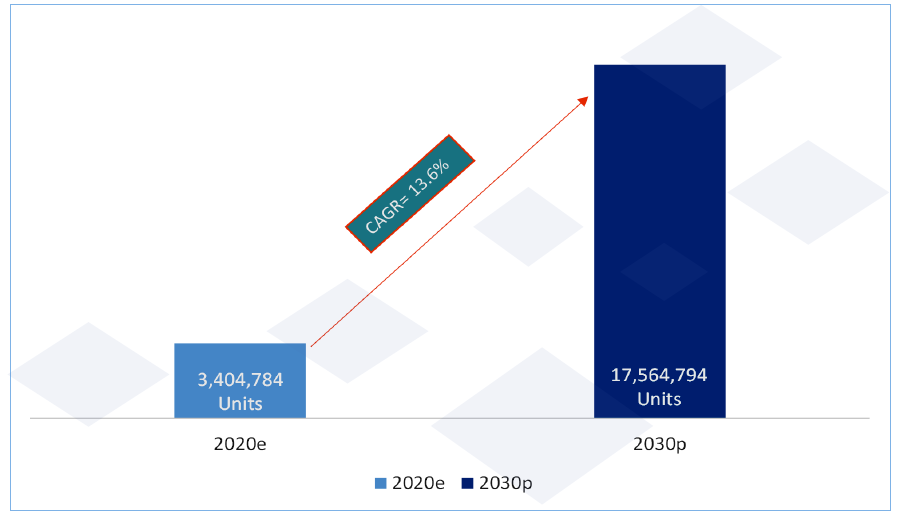
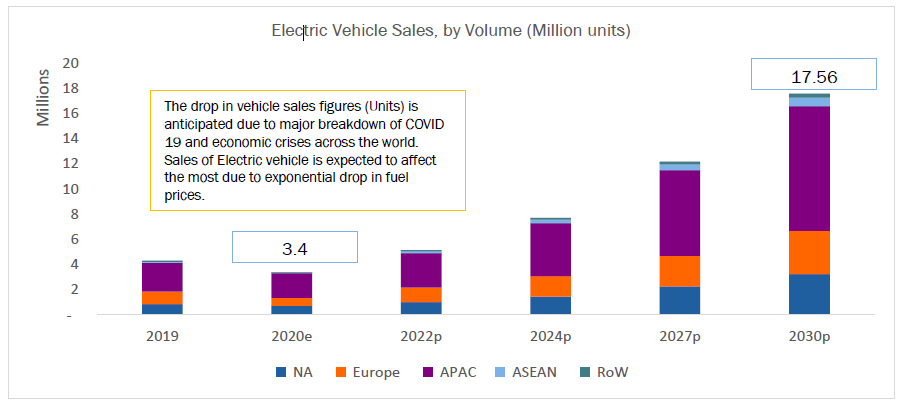
Pages (103), Tables (21), Figures (71) The Electric Vehicles Market is estimated to grow from 3,404,784 units in 2020 to 17,564,794 units in 2030 at a CAGR of 13.6%. • The encouraging initiatives for electric vehicles and huge investments by the major manufacturers is expected to spur the growth of electric vehicles. • Developing electric vehicle infrastructure, government mandates and rising emission controls are likely to propel the market. • Developed countries such as United States, Germany, Norway etc. are actively promoting the use of electric vehicles to reduce emissions. New Sales Of Electric Vehicles During The Forecasted Period (2019-2030p) • The base year for the report is 2019 and the forecasted period is 2020 to 2030. • The electric vehicle market has witnessed rapid evolution with ongoing developments in the automotive sector. • Adopting organic and inorganic strategies to prove the battery technology by improvising the cell efficiency and life cycle by major manufacturers and technology developers would drive the global electric vehicle sales. • The electric vehicle market is dominated by globally established players such as Tesla (USA), BYD (China), BMW (Germany), Volkswagen (Germany) and Nissan (Japan)
Technological advancements and greater government intervention in implementing new emission regulations and standards is anticipated to spur the growth of electric vehicles market across the globe.
New Sales Of Electric Vehicles During The Forecasted Period (2019-2030p)
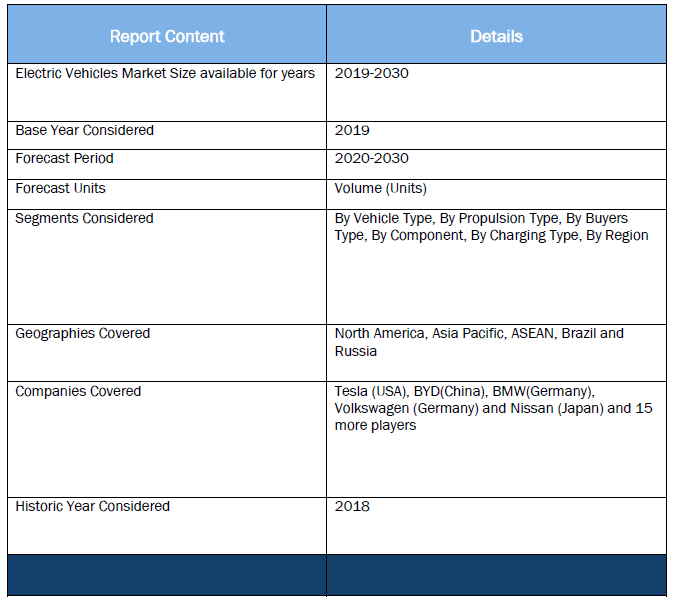
The base year for the report is 2019 and the forecasted period is 2020 to 2030.
The electric vehicle market has witnessed rapid evolution with ongoing developments in the automotive sector.
Adopting organic and inorganic strategies to prove the battery technology by improvising the cell efficiency and life cycle by major manufacturers and technology developers would drive the global electric vehicle sales.
The electric vehicle market is dominated by globally established players such as Tesla (USA), BYD (China), BMW (Germany), Volkswagen (Germany) and Nissan (Japan)
Premium Insights
Availability of models, reduced cost of investment and growth in charging infrastructure will promote the growth of electric vehicles across the globe
Attractive opportunities in electric vehicle market
• Electric vehicle market is expected to grow from 3,404,784 units in 2020 to 17,564,794 units in 2030 at a CAGR of 13.6% during the forecasted period.
• Asia Pacific is expected to lead the market followed by Europe and North America.
• Supporting government policies and regulations pertaining to the increasing usage of alternative fuels are responsible for expanding the footprint over the forecasted timeframe. • The increasing prevalence of greenhouse gases and carbon emission across the globe are forcing the government of various countries to take stringent steps to introduce polices to curb the pollution levels significantly. • The lower maintenance cost associated with the electrified vehicles along with reduced vibrations, instant torque and power output will further strengthen the penetration in the markets.
Mainstream buyer’s segment is expected to lead the market
• Mainstream buyers’ segment is expected to be the largest growing segment at a CAGR of 15.8% during the forecasted period (2019-2030). Luxury buyers is expected to follow the mainstream buyers at CAGR of 11% during the period. • Global shift towards consumer behaviour, growing sense of responsibility among young population and proven technology is sending a message to the manufacturers to concentrate on electrified vehicle production. • The electric cars come up with hand in hand new assistance technologies helping to automate some aspects of driving. With the technology getting mature in next 5 years, will drive the electric cars at competitive cost and lead to more mainstream buyers to purchase electric cars around the globe.
Scope Of The Report
The following are the questions addressed in the report: • What is the market size and growth rate for the regional markets considering various segments? • Which region or subsegments is projected to be the leader in the industry? • Which leading companies are working on the passenger and commercial electric models? • What are the upcoming trends in the market? How will it impact the industry? • What is the impact of the COVID 19 pandemic on the automotive industry? • Which country is supposed to be the market leaders? • What are the advancements happening in the space of electric vehicle components? • How is the scenario in the ASEAN market?
Introduction To Electric Vehicles (Page 4) 1.1. Objectives of Study
1.2. Market Definition and Years Considered Under The Study 1.2.1. Market Definition and Scope 1.2.2. Years Considered
1.3. Market Segmentation 1.4. Stakeholder Analysis 1.5. Currency and Pricing 1.6. Limitations of the Report
Research Methodology (Page 13) 2.1. Introduction: Secondary Research 2.2. Introduction: Primary Research 2.3. Market Size Estimation 2.4. Data Triangulation
Executive Summary (Page 15)
Premium Insights (Page 17)
4.1. Attractive opportunities in electric vehicle market 4.2. Mainstream buyers segment is expected to lead the market 4.3. Fuel cell electric vehicle is projected to be the fastest growing market 4.4. Passenger car segment is predicted to be the largest market across the globe
Market Dynamics (Page 22)
Industry Trends (Page 23) 6.1. Value chain analysis 6.2. Battery Types in Electric Vehicles 6.3. Supply and Demand Analysis for electric vehicles across the globe 6.4. Smart Charging 6.5. Disruptive market trends across the globe 6.6. Porter’s 5 Forces 6.7. EV Index Score
Government Regulations And Initiatives (Page 29) 7.1. Introduction 7.2. Government Initiatives in Asia Pacific Region 7.3. Government Initiatives in Europe Region 7.4. Government Initiatives in North America Region 7.5. Government Initiatives in ASEAN Region 7.6. Government Initiatives in RoW region
Impact Of COVID 19 Pandemic On Automotive Industry (Page 35) 8.1. Introduction 8.2. Impact Of Pandemic On Conventional Vehicles 8.3. Impact Of Pandemic On Autonomous And Electric Vehicles
Market Estimation And Forecasting By Vehicle Type (Page 36) 9.1. Introduction 9.2. Global Electric Vehicle Market, By Passenger Cars 9.3. Global Electric Vehicle Market, By Commercial Vehicles 9.4. Global Electric Vehicle Market, By Two Wheelers
Market Estimation And Forecasting By Propulsion Type (Page 38) 10.1. Introduction 10.2. Global Electric Vehicle Markets, By Battery Electric Vehicles 10.3. Global Electric Vehicle Market, By Hybrid Electric Vehicles 10.4. Global Electric Vehicles Market, By Fuel Cell Electric Vehicles
Market Estimation And Forecasting By Buyers Type (Page 41) 11.1. Introduction 11.2. Global Electric Vehicle Market, By Mainstream Buyers 11.3. Global Electric Vehicle Market, By Luxury Buyers 11.4. Global Electric Vehicle Market, by Commercial Buyers
Market Estimation And Forecasting, By Charging Infrastructure Type (Page 45) 12.1. Introduction 12.2. Global Electric Vehicle Market, By Normal Chargers 12.3. Global Electric Vehicle Market, By Fast Charger
Market Estimation and Forecasting, By Region (Page 47) 13.1. Introduction 13.2. Global Electric Vehicles Market, North America (By Country) 13.3. Global Electric Vehicle Market, Europe (By Country) 13.4. Global Electric Vehicle Market, Asia Pacific (By Country) 13.5. Global Electric Vehicle Market, By ASEAN (By Country) 13.6. Global Electric Vehicle Market, By RoW (By Country)
Global Electric Vehicle Market, By Component Type (Qualitative) (Page 61) 14.1. Advancements in battery cells and modules 14.2. On Board Chargers 14.3. Advancements in Electric Motors 14.4. Inverters
Company Profiles (Page 67) 17.1. Volkswagen AG 17.1.1. Company overview 17.1.2. Recent Developments 17.1.3. SWOT Analysis 17.2. BMW AG 17.3. Daimler AG 17.4. Groupe Renault 17.5. Toyota Motor Corporation 17.6. Tesla Inc 17.7. Nissan Motor Corporation 17.8. BYD 17.9. Hyundai Motor Company 17.10. Honda Motor Company 17.11. General Motors 17.12. Ford 17.13. Groupe PSA 17.14. TATA Motors 17.15. FCA 17.16. Fisker 17.17. LUCID Motors 17.18. WM Motors 17.19. Gelly 17.20. Mitsubishi Motors (Note: SWOT analysis is provided for the top 5 manufacturers of electric vehicles which is derived from the analysis. Major Electrified models and Key Recent developments is provided for the group.)
Challenges For The Advancements Of Electric Vehicles (Page 92)
Recommendations (Page 93)
Appendix (Page 94) 20.1. Key Insights From Industry Experts 20.2. Discussion Guide 20.3. Available Customization 20.4. References 20.5. Contact Us
Introduction
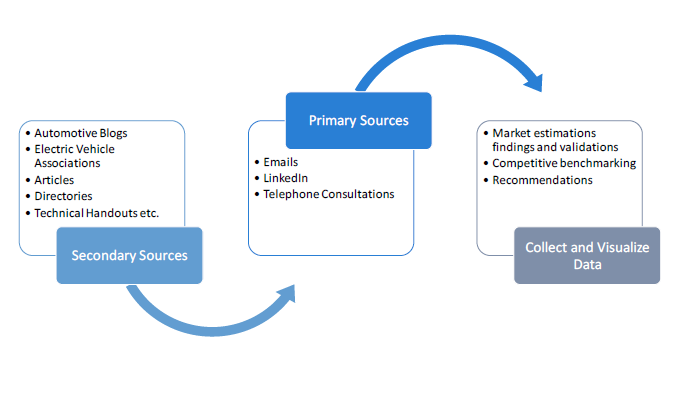
The study involved 4 major activities in estimating the market size of the electric vehicles market. Exhaustive secondary research was conducted to collect information on the market. The next step was to validate these findings, assumptions and market estimation and forecast with the industry experts across the value chain through primary research. The top down and bottom up approaches were selected to estimate the market sizing. Thereafter the market sizing for the segments and subsegments were estimated using data triangulation process.
Secondary Research
In secondary research various secondary sources like company annual reports/presentations, press releases, industry associations (such as publications of electric vehicles OEMs, country level automotive associations and trade organization, US department of transportation, electric vehicle magazines, automotive blogs, articles, directories, technical handbooks, World Economic Outlook, IMF (International Monetary Fund), IEA (International Energy Agency), other websites etc. were used to identify and collect the information useful for the pervasive commercial research study of electric vehicles market across the regions considered.
Figure 1: Process Flow
Introduction: Primary Research
Extensive primary research has been conducted after acquiring an understanding of the market scenario through secondary research. Several primary interviews have been conducted with the market experts from the demand and supply side of OEMs (Component supply, country level government associations and trade associations).
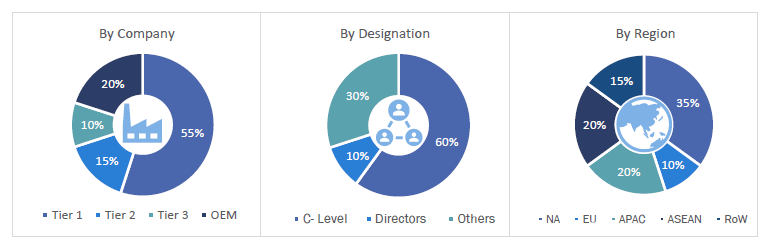
Approximately 20% and 80% of the primaries has been conducted for the demand and supply side respectively.
Primary data has been collected through questionnaires, emails, LinkedIn and telephonic Interviews.
In the consulting with primaries, I have tackled to cover various aspects of the study to cover various departments within organization such as sales and marketing, production and planning, research and development etc. to provide a comprehensive view of a report.
After interacting with various stakeholders (industry experts and retired professionals) to reinforce the findings from primaries.
Figure 2: Breakdown Of Primaries
Market Size Estimation
The top down and bottom up approaches were used to estimate and forecast the overall market size. These
methods were used extensively to estimate the market size of the various segments and subsegments. The
methodology is used to estimate the global market size for electric vehicles.
Key manufacturers and leading countries have been identified through extensive qualitative research.
The industry’s supply chain and market size in terms of volume have been determined through primary and secondary approach. /li>
All percentage shares, splits and breakdowns have been derived using secondary sources and verified through primary sources.
Data Triangulation Analysis
After reaching at the overall market size using the market estimation approach explained above the market is split
further into identified segments and subsegments. To complete the market engineering process and arrive at the
exact statistics of each market segment and subsegment, the market breakdown procedures were employed
wherever applicable. The data was formulated by studying current and future market trends like electrification,
connectivity, autonomous vehicles, increase in product life cycle etc. from the supply and demand side.
Objectives of Study
The objectives of the study are to analyse the perception and expectations of the consumers from the
OEM’s for alternative propulsion vehicles such as Hybrid/Electric and Fuel Cell vehicle
The study helps to strategically analyse the regional markets with respect to individual growth trends, future
prospects and contribution to total electric vehicle market
The report helps to understand the activities, launches and technological advancements carried out by
various major OEM’s across the globe and the start-up companies which are competing with them using
new vehicle platforms and additional technical features.
To segment and forecast the market as below:
1. By Vehicle Type (PC, CV and Two-Wheeler), By Volume (Million Units)
2. By Propulsion Type (Hybrid Electric Vehicle, Battery Electric Vehicle, Fuel Cell Electric Vehicle), By Volume (Million Units)
3. By Buyers Segment (Luxury Buyers, Mainstream Buyers, Commercial Buyers)
4. By Charging Station Type (Level 1, Level 2, DC Fast Chargers), By Volume (Million Units)
5. By Component Type (Battery and Module, Electric Motor, On Board Chargers, Inverters) (Qualitative)
To provide detailed information regarding the major factors influencing the EV market trends (Drivers, Challenges, Restraints and Opportunities).
To analyse regional markets with respect to the current and future trends in the market and government initiatives to support the growth of electric vehicles.