
Global Automotive LiDAR Market
-
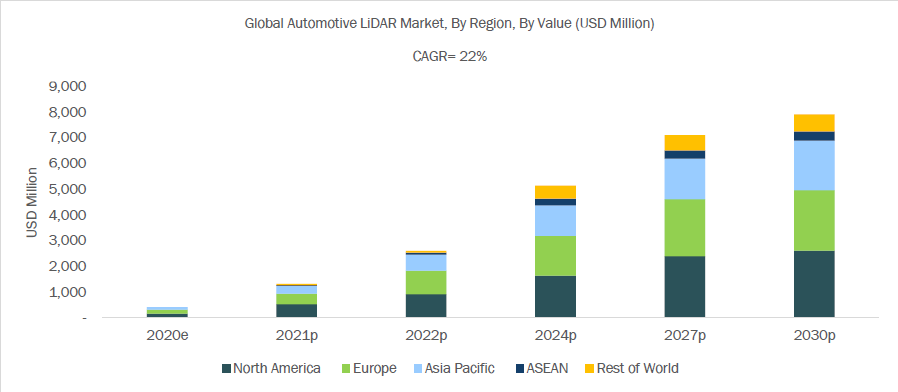
- Pages (100), Tables (18), Figures (70). The Global Automotive LiDAR Market is projected to grow at a CAGR of 22% during the forecasted period (2021-2030) and is estimated to grow from USD 1319.75 Million in 2021 to USD 7913.96 Million in 2030.
• There is substantial growth in the vehicles with ADAS features and testing prototype of self-driving vehicles in key regions across the globe. This is specifically due to safety concerns, rising customer demand and development in research and development activities.
• Cameras/Radars/Ultrasonic sensors are unable to meet the requirements due to various operational limitations of sensors which in effect raises the need for the usage of LiDAR to achieve level 5 automation.Global Automotive LiDAR Market During The Forecasted Period (2019-2030p)
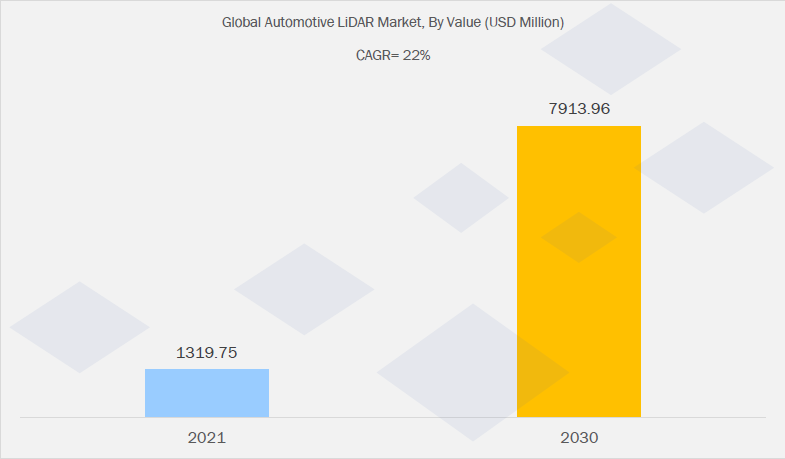 • The base year for the report is 2021 and the forecasted period is 2022 to 2030.
• Many automotive manufacturers and OEMs are making significant investments to develop technologies for autonomous vehicles. Companies such as Delphi, Continental, Robert Bosch, Daimler, Scania, Volvo, General Motors, Ford etc. are working to develop semi-autonomous vehicle models and testing prototypes of self-driving vehicles.
• Adopting organic and inorganic strategies to prove the sensor contribution to solve the ODD
(Operational Design Domain), cost, reliability and production scalability are decisive factors for the deployment of large number of fleets (Level 3 to Level 5).
• The Global Automotive LiDAR Market is dominated by globally established players such as Continental AG (Germany), Denso Corporation (USA), Robert Bosch GmbH (Germany), Velodyne Lidar Inc. (USA) and ZF Friedrichshafen (Germany). The future is moving towards semi-autonomous and autonomous cars, the technologies in the space is advancing quickly to cope up with the market trends.
• LiDAR (Light detection and ranging) is a sensing method that detects objects and maps their distances.
• The technology works by illuminating the target with an optical pulse and measuring the characteristics of the reflected signal in return. The width of the optical-pulse range from a few nanoseconds to several microseconds.
• Manufacturers are inducting the modern cars with advanced control and sensing functions.
• Collision warning and avoidance systems, blind spot monitors, lane keeping assist, lane departure warning and adaptive cruise control are examples of established features that assist the drivers and allows to automate certain driving tasks.
• LiDAR and Radar systems can detect the objects at distances ranging from a few meters to 200 meters.
• LiDAR is the new entrant in terms of technology offers in the space of automotive sector but this is spurring rapid innovation with more established sensory systems.Premium Insights
In addition to automotive industry, the LiDAR technology is been used extensively by many end user industries such as aerospace, agricultural and civil engineering industries that has resulted to declining trend of manufacturing costs.
• The Automotive LiDAR market is expected to rise across the globe due to more and advanced ADAS features getting inducted into the vehicles and growth in the autonomous vehicles such as Robotaxis and Autonomous shuttles in the regions like North America and Europe.
• A drop in the investments is observed in the year 2020 due to the COVID 19 pandemic and new sales of ADAS featured vehicles is likely to get hampered because of global recession.
• Key vehicle manufacturers have taken a decision to reduce the investments into research and development activities of autonomous vehicles and delay it by 12- 18 months to recover the losses and LiDAR manufacturers have postponed the launches of new LiDAR models.
• A gradual increase in the semi-autonomous & autonomous vehicles will be observed beyond 2021 due to the increase in customer demand and proven technology across the globe.
Global Automotive LiDAR Market, By Value (USD Million)
The Solid-State LiDAR Market Is Expected To Be The Largest Market Segment (By Volume And By Value) Among Other Lidar Technologies.
• The Solid-State LiDAR is projected to grow from USD 1167.90 Million in 2021 to USD 6948.39 Million at a CAGR of 21.9% during the period (2021-2030).
• Automotive LiDAR is the key technology for the advancements of self-driving vehicles as it is capable of delivering high definition projections (2D and 3D) of the surroundings. Most notably, the latest advances in the LiDAR technology are able to differentiate between a person walking on the road, trees, bike, car and nearby obstacles.
• This LiDAR is best suited for the Semi-Autonomous vehicles as LiDAR models are smaller in size, lighter and more cost effective compared to the mechanical/scanning LiDAR.
• The models can provide increase range and resolution required for high speed driving. As there are no moving parts hence, the LiDAR is immune to shock and vibration and therefore less prone to motion blur. The Bumper And Grill Vehicle Location Segment Is Projected To Be The Largest Segment By Value
• The Bumper and Grill Location segment is expected to be the largest among others and is expected to grow from USD 470.68 Million to USD 2735.67 Million at a CAGR 21.6%. during the forecasted period (2021-2030).
• Each sensor is chosen on the basis of the factors like accuracy, range, sampling rate, FOV (Field Of View), cost and overall system complexity.
• This location is chosen by the vehicle manufacturers and LiDAR manufacturers specifically because it is possible to achieve a better FOV without affecting the appearance of the vehicle.
• This has a simple setup and good integration in to the vehicle and helps to detect even the
low obstacle hitting the vehicle.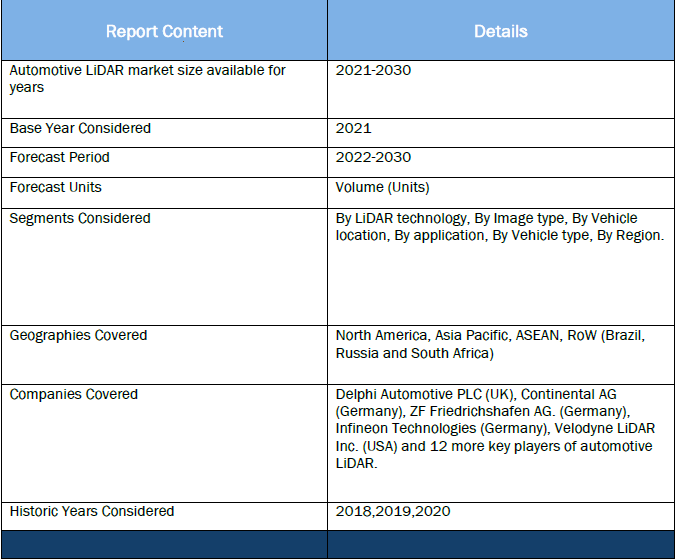
The following are the questions addressed in the report:
• What is the market size and growth rate for the regional markets considering various segments?
• Which region or subsegments is projected to be the leader in the industry?
• What are the driving factors for the global automotive LiDAR market?
• Which leading companies are working on the semi-autonomous and autonomous vehicles?
• What are the upcoming trends in the market? How will it impact the industry?
• Which country is supposed to be the market leaders?
• What are the advancements happening in the space of automotive LiDARs?
• How is the scenario in the ASEAN and Rest Of World (Russia and Brazil)?
• Which application will dominate the global automotive LiDAR market during the forecasted period?
- Pages (100), Tables (18), Figures (70). The Global Automotive LiDAR Market is projected to grow at a CAGR of 22% during the forecasted period (2021-2030) and is estimated to grow from USD 1319.75 Million in 2021 to USD 7913.96 Million in 2030.
-
- Introduction To Automotive LiDAR
1.1. Objectives of Study
1.2. Market Definition and Years Considered Under The Study
1.2.1. Market Definition and Scope
1.2.2. Years Considered
1.3. Market Segmentation
1.4. Stakeholder Analysis
1.5. Currency Rates
1.6. Limitation and Assumptions in the Project
1.7. List Of Figures
1.8. List Of Tables
1.9. Abbreviations
- Research Methodology
2.1. Introduction: Secondary Research
2.2. Introduction: Primary Research
2.3. Market Size Estimation
2.4. Data Triangulation - Executive Summary
- Premium Insights
4.1. Solid State LiDAR Market is expected to be the largest market segment by Volume (Units) and by Value (USD Million) among other technologies
4.2. Bumper and Grill Vehicle location segment is the largest market segment byvalue
4.3. Semi-Autonomous Vehicles is expected to be the largest growing market segment
4.4. Battery Electric Vehicles are predictable to lead the market compared to other propulsion systems.
4.5. Regional Analysis: Global Automotive LiDAR Market - Market Overview
5.1. Market Dynamics
5.1.1. Drivers, Restraints, Opportunities and Threats Analysis
5.2. Porter’s 5 forces analysis
5.2.1. Competitor’s Rivalry
5.2.2. Bargaining Power Of Buyers
5.2.3. Bargaining Power Of Suppliers
5.2.4. Threat Of Substitutes
5.2.5. Threat Of New Entrants
5.3. Potential OEMs For LiDAR Applications Across Geographical Location. - Industry Trends
6.1. Key Trends in Automotive LiDAR Market
6.2. Role Of LiDAR technologies in Automotive Industry
6.2.1. Mechanical LiDAR Sensors
6.2.2. Solid State LiDAR Sensors - Automotive LiDAR Sensor Market, By Technology
7.1. Introduction (individual cost)
7.2. Solid State LiDAR
7.3. Mechanical/Scanning LiDAR
7.4. Flash LiDAR - Automotive LiDAR Sensor Market, By Vehicle Location
8.1. Introduction
8.2. Bumper and Grill
8.3. Headlight and Taillight
8.4. Roof structure and Pillars (A, B and C)
8.5. Windscreen and ORVM
8.6. Others - Automotive LiDAR Sensor Market, By Application
9.1. Introduction
9.2. Semi-Autonomous Vehicle
9.3. Autonomous Vehicle - Automotive LiDAR Sensor Market, By Vehicle Type
10.1. Introduction
10.2. Conventional Vehicle
10.3. Hybrid Electric Vehicle
10.4. Battery Electric Vehicle - Market Estimation and Forecasting, By Region
11.1. Introduction
11.2. Global Electric Vehicles Market, North America (By Country)
11.2.1. USA
11.2.2. Canada
11.2.3. Mexico
11.3. Global Electric Vehicle Market, Europe (By Country)
11.3.1. Germany
11.3.2. France
11.3.3. Italy
11.3.4. Spain
11.3.5. UK
11.3.6. Czech Republic
11.4. Global Electric Vehicle Market, Asia Pacific (By Country)
11.4.1. China
11.4.2. Japan
11.4.3. South Korea
11.4.4. India
11.4.5. Australia
11.4.6. New Zealand
11.5. Global Electric Vehicle Market, By ASEAN (By Country)
11.5.1. Singapore
11.5.2. Thailand
11.5.3. Indonesia
11.5.4. Malaysia
11.6. Global Electric Vehicle Market, By RoW (By Country)
11.6.1. Russia
11.6.2. Brazil
11.6.3. South Africa - Competitive Landscape
12.1. Introduction
12.2. Visionary Leaders
12.3. Innovators
12.4. Emerging Companies
12.5. Dynamic Differentiators
- Company Profiles
13.1. Continental AG.
13.1.1. Company overview
13.1.2. Recent Developments
13.1.3. SWOT Analysis
13.2. ZF Friedrichshafen AG.
13.3. Infineon Technologies
13.4. Velodyne LiDAR Inc.
13.5. Texas Instruments Incorporated
13.6. First Sensor AG.
13.7. Leddartech Inc.
13.8. Aptiv
13.9. Innoviz Technologies Ltd.
13.10. Valeo S.A.
13.11. Xenomatix N.V.
13.12. Ibeo Automotive Systems GmbH
13.13. Sense Photonics
13.14. Panasonic Corporation
13.15. Luminar Technologies Inc.
13.16. Denso Corporation
(Note: SWOT analysis is provided for the top 5 manufacturers of electric vehicles which is derived from the
analysis. Major Electrified models and Key Recent developments is provided for the group.) - Challenges For The Advancements Of Automotive LiDAR
- Recommendations
- Appendix
16.1. Key Insights From Industry Experts
16.2. Discussion Guide
16.3. Available Customization
16.4. References
16.5. Contact Us
16.6. About Gravitas Automobil Markt
- Introduction To Automotive LiDAR
-
Research Methodology
Introduction: Secondary Research
The study involved 4 major activities in estimating the market size of the automotive LiDAR market.
- The study involved 4 major activities in estimating the market size of the automotive LiDAR market. Exhaustive secondary research was conducted to collect the information.
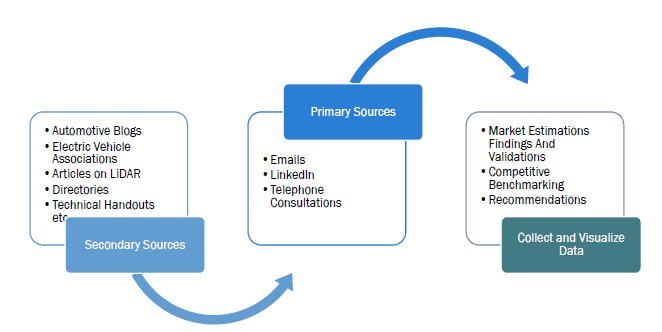
- Various secondary sources, such as company website, blogs, press releases, industry associations, magazines, articles, handouts, directories, World Economic Outlook and companies databases have been used to identify and collect information.
- The top down and bottom up approaches were selected to estimate the market sizing.
- Thereafter the market sizing for the segments and subsegments were estimated using data triangulation process.
Process Flow
Introduction: Secondary Research
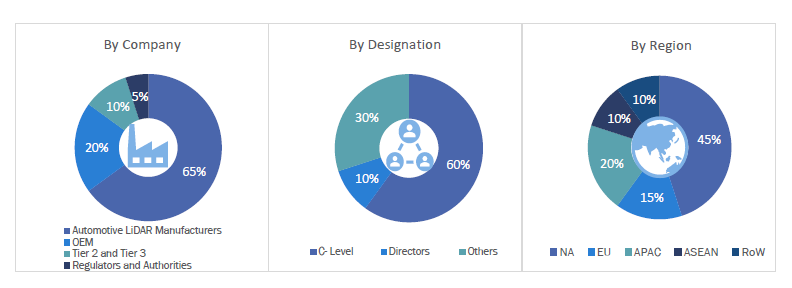
- Extensive primary research has been conducted after acquiring an understanding of the market scenario through secondary research. Several primary interviews have been conducted with the market experts from the demand and supply side of OEMs (Component supply, country level government associations and trade associations).
- Approximately 20% and 80% of the primaries has been conducted for the demand and supply side respectively.
- Primary data has been collected through questionnaires, emails, LinkedIn and telephonic Interviews.
- In the consulting with primaries we have strived to cover various aspects of the study to cover various departments within organization such as sales and marketing, production and planning, research and development etc. to provide a comprehensive view of a report. After interacting with various industry experts and independent consultants to reinforce the findings from primaries.
- The top down and bottom up approaches are used to estimate and validate overall market size. These methods were used extensively to estimate the market size of the various segments and subsegments. The methodology is used to estimate the global market size for production of vehicles with automotive LiDAR.
- Key players and the markets have been identified through extensive research.
- The industry’s supply chain and market size in terms of volume and value have been determined through primary and secondary research processes.
- All percentage shares, splits and breakdowns have been determined using secondary sources and verified through primary sources.
- After reaching at the overall market size using the market size estimation processes explained above the market split into several segments and subsegments. To complete the market engineering process and arrive at the exact statistics of each market segment and subsegment and market breakdown procedures were employed wherever applicable. The data was formulated by studying various factors from the supply and demand side.
- The objective of the study is to define, forecast and analyse the automotive LiDAR market (2021- 2030) in terms of volume (‘000 units) and by Value (USD Million)
- To analyse the regional markets and countries considered under the study for growth drivers, future market trends and overall market size.
- The research report helps to understand the activities, launches and technological advancements carried out by various automotive LiDAR manufacturers and identifying any start-up companies competing with them.
- The classification of the study for automotive LiDAR market has been performed as follows:
1. By LiDAR technology (Solid State LiDAR, Mechanical/Scanning LiDAR and Flash LiDAR), by Volume and by Value (USD Million)
2. By Vehicle Location (Bumper and Grill, Headlight and Taillight, Roof Structure and Pillars (A, B and C), Windscreen and ORVMs), by Volume and by Value (USD Million).
3. By Application (Semi-Autonomous and Autonomous Vehicles), by volume and by value (USD Million)
4. By Vehicle Type (Conventional Vehicle, Hybrid Electric Vehicle, Battery Electric Vehicle) - To provide detailed information regarding major factors influencing the automotive LiDAR market trends (DROC analysis).
Breakdown Of Primaries
Market Size Estimation
Data Triangulation
Data Triangulation